


Earth @ Risk
Gabriola Library Show Spring 2025
.2024 was the hottest year on record This trend is continuing into 2025, as January was "the 18th month in the last nineteen months for which the global-average surface air temperature was higher than 1.5C above the pre-industrial level" according to earth.org Increasing emissions of greenhouse gases from the following causes are causing warmer temperatures (according to climate.ec.europe.eu):
-
Burning coal;
-
Oil and gas production;
-
Carbon dioxide and nitrous oxide;
-
Cutting down forests (deforestation). Trees help to regulate the climate by absorbing CO2 from the atmosphere. When they are cut down, that beneficial effect is lost and the carbon stored in the trees is released into the atmosphere, adding to the greenhouse effect.
-
Increased livestock farming. - Cows and sheep produce large amounts of methane when they digest their food. Fertilizers containing nitrogen produce nitrous oxide emissions. Fluorinated gases are emitted from equipment and products that use these gases. Such emissions have a very strong warming effect, up to 23,000 times greater than CO2.
UN.org states that warmer temperatures over time are changing weather patterns and disrupting the usual balance of nature. This poses many risks to human beings and all other forms of life on Earth
I created these artworks to share my concerns and visions of what some of the impacts of Climate change could be
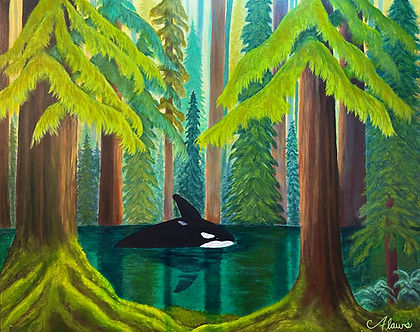
EXPANDING HORIZONS 30" × 24" Acrylic $500
Global Warming is causing glaciers to melt and raising concerns about levating ocean levels According to the royalsociety.org, "Arctic summer sea ice cover has shrunk dramatically. The heat content of the ocean has increased. Global average sea level has risen by approximately 16 cm (6 inches) since 1901, due both to the expansion of warmer ocean water and to the addition of melt waters from glaciers and ice sheets on land. Warming and precipitation changes are altering the geographical ranges of many plant and animal species and the timing of their life cycles."This piece imagines what could happen when the sea levels rise, flooding the rain forests of west coast Vancouver Island.

HOPE 20"x16" Acrylic $350
Sea Ice in the Arctic is melting at an alarming rate due to Global Warming severely affecting polar bear habitat. Polar Bears need sea ice to hunt for the food they need to survive. They hunt seals using ice flows to sneak up on the seals sleeping on the ice or swimming under the ice. They rarely can catch seals in open water. In areas where the ice melts and freezes, like the Hudson Bay, polar bears have adapted to fasting on land in the summer months (eating only berries and plants) but this does not sustain them. Weather changes due to climate change have shortened the winter season keeping the bears on land longer, resulting in a shorter seal hunting season. This greatly reduces their chance of survival. Populations of polar bears in these regions are reducing.
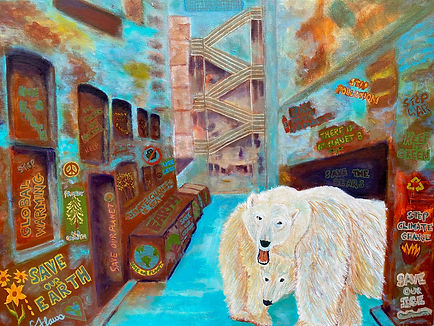
LOST 24" × 18" Acrylic $500
Imagine a world where our changing climate causes animals to lose their habitat and cut off access to their food sources resulting in animals having to start looking for alternate food sources. Cities provide a good source of food in garbage so the animals move into the cities to get their food where garbage bins are cluttering the back alleys and dumps. This piece imagines what could happen when polar bears lose their sea ice and begin hunting in the city for food sources.

DESERT MELT 36"×24" Acrylic $500
Can you feel the heat? Deserts are getting hotter and hotter.Sandstorms caused by droughts can move tons of sand across continents, expanding deserts into agricultural, land, impacting food growth. Many people are experiencing reduced availability of drinking water.According to Natural Geographic, "Rising temperatures can have huge effects on fragile desert ecosystems. In deserts, temperatures are rising even faster than the global average. This warming has effects beyond simply making hot deserts hotter. Heat prevents microbes from converting nutrients to nitrates, which are necessary for almost all living things. This can reduce the already limited plant life in deserts."

CATHEDRAL GROVE 16"×20" Acrylic $350
One of my favourite places on Vancouver Island, Cathedral Grove, is one of very few remaining old growth forests in British ColumbiaWhy have we destroyed so many of these majestic towers We have taken away some of our best tools that the Earth has to absorb carbon dioxide from the atmosphere as thee giant trees store it in their wood, leaves and roots.When we cut them down, the carbon releases back into theatmosphere further exacerbating climate changeAccording to the Climate Portal at MIT, "humans have cleared up to half of the forests on our planet, mostly to make room for agriculture."Treesrelease moisture that cools the air around them.Deforestation is"contributing to more intense heat waves in North America"

PLANET B? 20"x16" Acrylic $350
Some people fantasize that we can move to Mars once we destroy our planet.If it was even feasible to get there, could you imagine what it might be like to live there. We would have to live in protected living quarters and move around in tunnels like rats, and wear protective suits. Assuming we could survive physically and be suitably protected from the elements, how would we survive mentally.Nature on Earth is our grounding place The beauty of the forests and the skies give us peace and improve our well-being. What would it be like to live enclosed with walls all around us. How many people could be contained in these quarters.

DRY RUN 20"x16" Acrylic $350
As the earth becomes warmer, water sources are drying up and becoming scarce in more and more regions. Rivers and lakes are already experiencing drought right here in BC causing significant impacts to the salmon runs.According to the DFO, "it is increasingly common for some areas of fish habitat to dry up, or "dewater", during B.C's dry, warm summer months.This can cause salmon to be trapped in isolated pools, which puts them at risk due to lack of oxygen, warm water temperatures, lack of food, and increased exposure to predators."Loss of water in streams and riverbeds can delay or block salmon migrations to spawning areas needed for reproduction."

ECHOES of EVANESCENCE 20"x16" Acrylic $350
Humans leave their mark on Earth in many ways. Abandoned homes are often left to rot in nature's forces. They may contain toxic contaminants left behind, and become eye-sores to their neighbourhoods. They attract pests and wildlife. Nature will eventually take over and work its way through the construction materials left behind. When you see an abandoned house being overtaken by nature, do you ever wonder what stories are behind that home? Who lived there and why did they just leave it?
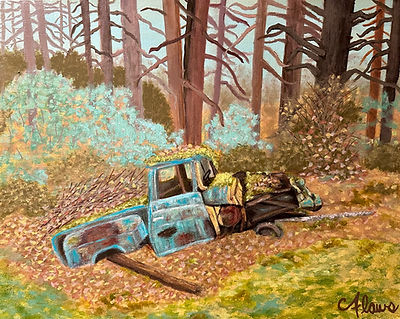
RECLAMATION 20"×16" Acrylic $350
Why do people just abandon old vehicles, leaving behind metal and plastics and whatever chemicals might have been left in the engine? This car has been abandoned in this trail for many years.With each passing year, Mother Nature reclaims more and more of this old car. The metal is rusting away and moss envelopes the exterior. Branches find a path through the broken pieces and window openings. Eventually the vegetation will take over and you will hardly know there is scrap metal buried beneath

ENTANGLEMENT 20" × 10" Acrylic $250
Humans! There are too many of us and too many who are careless. We have turned to mass methods of fishing with large nets collecting more than than desired, resulting in huge waste and loss of life for other species collected in the nets. Nets often get caught and torn and pieces litter the ocean, causing hazards for all creatures We have created so much waste that ends up in landfills or discarded into the ocean. Animals and birds end up dead after eating plastics and other toxins dumped into their world by humans

RESURGENCE 20"x16" Acrylic $275
Longer and longer periods of drought caused by global warming has increased the risk of forest fires. Each year we are losing more and more habitat to fires.What happens to all of the poor creatures who livedthere? Did they have a chance to escape? Did they burn along with the trees that they build their homes in?We have seem more and more fires encroaching on human habitats as well causing people to lose their homes and sometimes their lives. As the earth is getting hotter and the climate is changing, we will only encounter more tragedy.It fascinates me how nature finds a way to survive after such devastation.This piece shows a glimmer of hope for the forest's recovery with the resurgence of vegetation growing out of the ashes. Nature may survive, but will it be with or without us?

NURSE TREE 16"x20" Acrylic $350
Nurse trees fascinate me. I don't know if that's a real term or if I just made it up? I love nature's way of refurbishing itself. Logging and storms leave stumps behind and Mother Nature leverages the nutrient rich remains to support new life. Nature has a way of surviving many of the challenges we have thrown at it.

RAIN STORM 36"x24" Acrylic $500
Rising temperatures are causing the oceans to become warmer and warmer. Warm ocean currents help storms to grow in strength and force.
As the earth is getting warmer, the frequency and intensity of storms have increased, causing more and more devastation.

MALASPINA ARBUTUS 12"x16" Oil $275
Arbutus trees are at risk in BC due to climate change, drought and human disturbances. According to treeplantation.com" Arbutus trees hold significant cultural and spiritual value in indigenous cultures. It is a symbol of strength, survival and resilience. Indigneous communities have traditionally used the tree's leaves, bark and berries for medicinal purposes.
Summer droughts are longer and more severe than in historical record. Many trees have contracted a fungus called leaf blights. Hotter, dryer, extended summers weaken the trees unable to ward off the fungus.

CURIOUS FAMILY 12"x12" Acrylic $150
Polar Bears are classified as a vulnerable species. Their survival depends greatly on sea ice and their ability to hunt seals. While the do eat berrys and other plants through the summer, they cannot survive without the fat from seals As the climate warms, there is a greater risk to their habitat and survival.

OTTO THE SEA OTTER 12"x12" Acrylic $150
According to earth.org, by the early 1900's the Sea Otter was on the brink of extinction due to the fur trade. Thanks to conservation efforts and protection measures in Canada, their population has soared to over 6500 around the coasts of British Columbia.They are still considered endangered globally by the IUCN.They are now vulnerable to new threats due to bycatch, entanglement in active and abandoned fishing gear, marine pollution and oil spills. Sea Otters fur highly susceptible to hypothermia if their fur comes into contact with oil.

JUNIOR AND MALALA 20"x16" Acrylic $350
Mother Nature tells some amazing stories of survival A webcam temporarily installed overlooking an Eagle's nest on Gabriola taught us some fascinating survival stories. The parents had two eggs. Both hatched but one of the babies didn't survive. .One day the parents brought in a baby red-tailed hawk to feed it to its surviving baby (whom we named Junior.) Junior didn't want to eat it The brave little hawk started squawking until they eventually started feeding it as well. We named the baby hawk Malala (after a woman in the middle east who was a brave survivor). Malala grew up to be a strong and healthy red tail hawk. Junior unfortunately encountered a tragic demise due to a struggle with Hydro wires (another man-made tragedy). Thankfully his death wasn't in vain as it created a lot of uproar among concerned nature enthusiasts which triggered Hydro to finally put some measures in place to protect Eagles from electrocution.

Spotted Leopard Frog 10"x8" Acrylic $125
According to Wikipedia, "this species was once quite common through parts of western Canada and the United States until declines started occurring during the 1970s. Although the definitive cause of this decline is unknown, habitat loss and fragmentation, environmental contaminants, introduced fish, drought, and disease have been proposed as mechanisms of decline and are likely preventing species' recovery in many areas"

Waiting for the Ice 8"x8" Ink - Sold
Polar Bears struggle to survive much longer than 150 days without fat from seals. In recent years, they have had to struggle more than 170 days on land waiting for the ice to form to allow them to start hunting.

Covid and Climate Change
This sculpture was created for an exhibit for the Gabriola Arts Council interpreting Climate change and Covid impacts on the environment. It was interesting to hear stories of more and more animals that found their way into cities when there was no humans around. I imagined what the world might look like with climate change impacting sea levels causing animals to be forced to move towards the cities with their natural food availability dwindling as the ice was no longer there for help them to hunt seals
NOTE: Please see Desktop version for photos of art from this show. I'm working on trying to resolve why only some are appearing on mobile version